“If this is your first time being poor...”
"If this is your first time being poor...". This is how TikTok creator Kiki Rough opens her videos, in her kitchen in Indiana, creating another dish for her "Recession Recipe" series: bean “meat” loaf, “chicken nuggets” from chickpeas, French toast casserole. The dishes are not fancy; they are not healthy. But they are affordable. They are struggle meals that use cheap ingredients and stretch those pantry staples.
Food prices have increased 20% since 2022 , so you can draw a straight line between the rise in content creators sharing their struggle meals and how much your weekly grocery shop costs. Social listening data from YouScan supports this. Looking across the last year, affordability dominates the conversations: cheap, budget, easy meals. Meal preparation heavily leans into this, as people are not just looking for recipes, but systems and routines that save costs and time, while also being healthy and nutritious. Convenience is another driver here. It’s less about creativity, as people want to reduce the effort in preparing meals as well as in making decisions. Feeding your family firmly sits within that cluster, how to feed your family efficiently, while also catering to picky eaters. Health factors into that but is secondary. It’s more of a practical conversation, how to make a meal healthy within limited means.
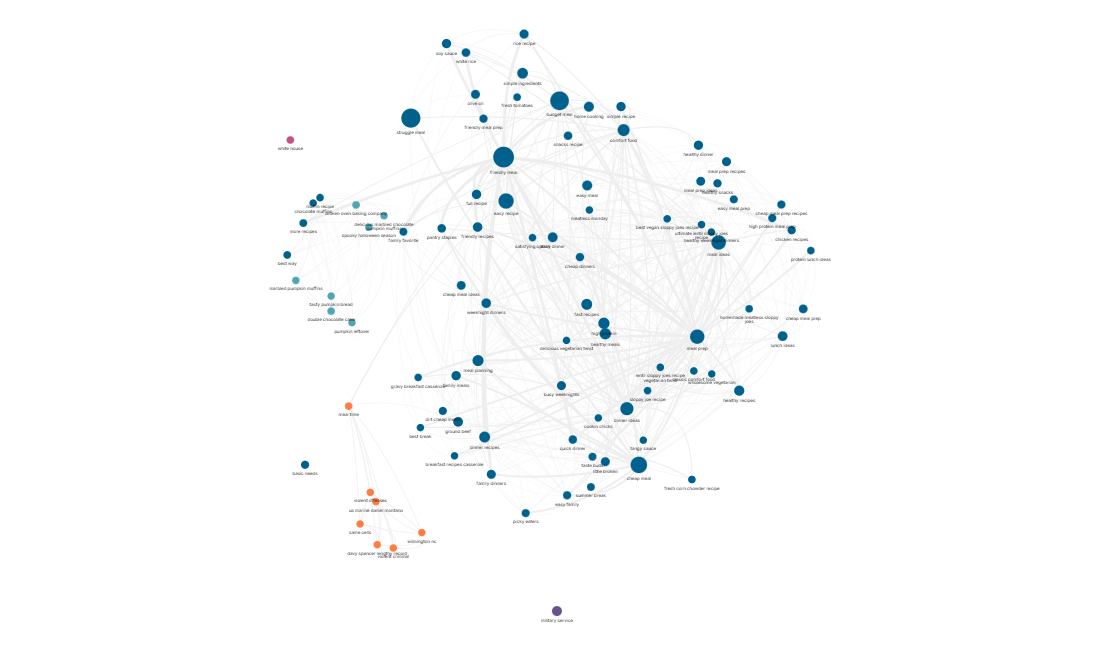
YouScan conversation clusters
What is interesting is that there is very little evidence of shame, guilt, embarrassment or stigma in these conversations. Recession recipes, struggle meals, they often all get tarred with the same brush of being too processed, having too much sugar, fat, salt, not having enough protein. Peasant food. There is always a commenter judging the dish, trying to turn it into a negative. But those who create struggle meal content are openly discussing their financial constraints. For them it’s more about problem-solving, rather than judgement. The “struggle” label helps with that. No one is glossing over the hardship or romanticising it. It does not need to be hidden. So you can discuss it openly rather than hide it.
Many of us will have a struggle meal from our own childhood. In Germany, “Arme Leute Essen” (poor people's food), is often tied to post-war scarcity and more recently to the nostalgia of the former DDR (East Germany). When I googled German struggle meals, I got a list that included Semmelknödel, Kartoffelsuppe, Bratkartoffeln, Kartoffelpuffer, Pellkartoffeln mit Quark, Kohlrouladen, Eintopf, Königsberger Klopse, Falscher Hase, Grießbrei. All of them were staples in my childhood. I would have never called them struggle meals.
I don’t have a memory of food scarcity. But I also did not have to manage the household budget. So the scarcity got filtered out, because I never had to carry that burden. The memory that I have is based on what the food tasted like and who made it. This is why the adult version of the struggle meal can be so comforting. It’s not the memory of scarcity; it’s the memory of someone feeding you.
When you view struggle meals through the lens of nostalgia, the judgement disappears completely. It becomes Oma’s recipe instead of peasant food. And once it becomes a person, it is much harder to criticise the person than the food. The food hasn’t changed. The same “unhealthy” peasant food, full of carbs, fat, sugar, salt, becomes “wholesome” when you follow Oma’s recipe to make it. Moralising food on social media is common, but nostalgia manages to override this and give legitimacy to something that was once shamed. Once Oma is involved, struggle meals become safe, stable, remembered, even virtuous.
The yearning for the same struggle meals as an adult has the option of choice. As a child, your struggle meal was the only option, you could not choose the ingredients, the portions or how often you would eat it. As an adult, the same constraints become a luxury of choosing simplicity, which changes a powerless memory into an act of control. Making a struggle meal now shows that you can choose, which turns shame into comfort. The nostalgia does not to take you to the past. It’s making you feel cared for in the present.
The appeal of a struggle meal intensifies during economic uncertainty. This is why Kiki Rough’s channel now has more than half a million followers. The “recession recipe” series is her most popular. These are recipes that got your parents and your parents’ parents through hard time. They are tried and tested. Whether you are craving the taste of your childhood, the memory of being cared for, or the resourcefulness of cooking entire meals with very few ingredients, struggle meal seem to be able to do all three.