The Rituals We Buy: Advent Calendars As Self-Care
This morning you might have stood in your kitchen in front of a cardboard box that cost more than your weekly shop. The Nespresso machine is rattling away, the heating hasn't quite kicked in yet, and you're rubbing the sleep from your eyes. You peel open door number 4. It reveals a miniature luxury hand cream. Yeah! You'll probably lose that in your capacious handbag, but for about fifteen seconds, something in your chest unclenches. Not happiness exactly. More like a sign that today is more than the usual routine of just getting through it.
And this is how we turn anticipation itself into a product you can buy at Boots.
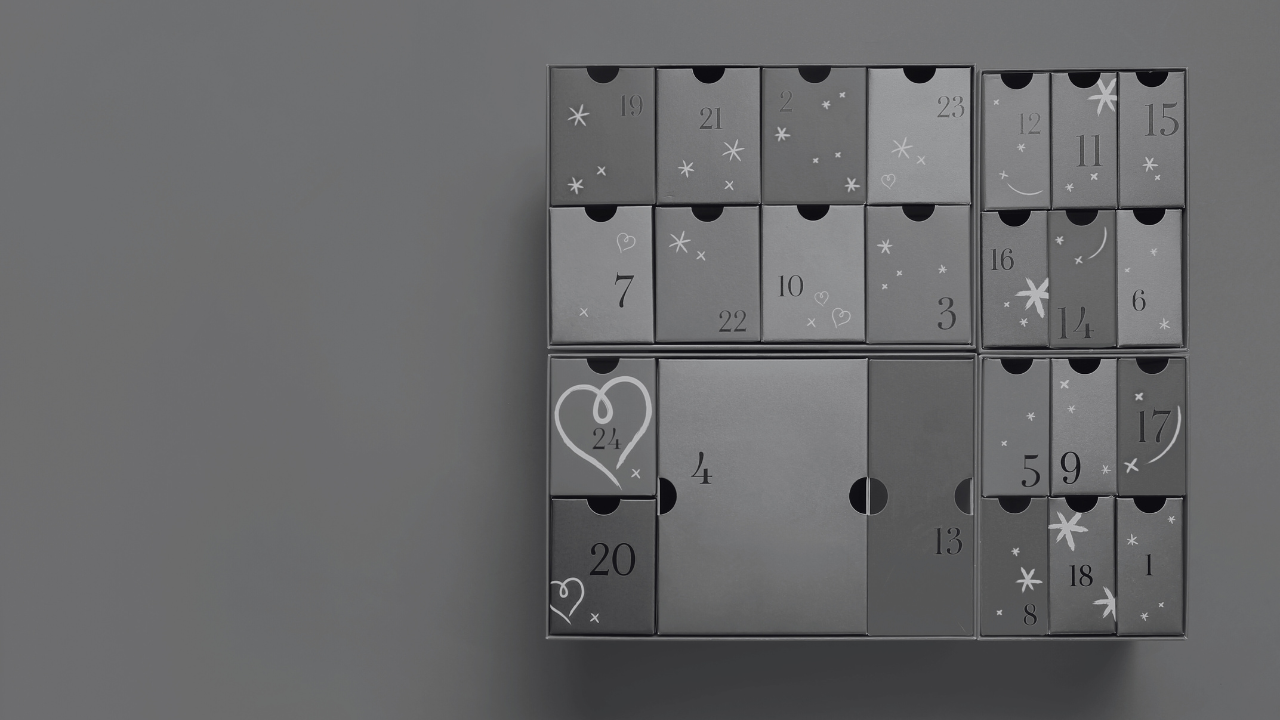
Image by pixelshot
The advent calendar's journey from religious countdown to luxury status is a case study in how capitalism identifies the scaffolding of meaning – ritual, anticipation, the human need for structured time - and repackages it as purchasable experience. And we willingly participate in it. And that willingness reveals our contemporary anxiety.
Gen Z didn't invent treating themselves, but they've professionalised it as "little treat" culture: the matcha latte, the blind boxes, the sheet mask on a Tuesday evening. It works as a coping mechanism for navigating a world that feels simultaneously overstimulated and underwhelming. Advent calendars slot perfectly into this world of micro-rewards. They're not indulgence so much as maintenance. Daily proof that you're taking care of yourself. They are self care.
Self care - the language around this is telling. Not gift but care, medicalised and necessary. The reframing transforms consumption into wellness practice, spending into something virtuous. You're not buying things you don't need. You're constructing moments of pause in a season that demands constant motion.
Except, of course, you're doing nothing of the sort.
The advent calendar began as a Protestant practice in 19th century Germany: families lighting candles, marking chalk lines on doors, hanging daily images to count down the weeks before Christmas. By the early 1900s, publisher Gerhard Lang had commercialised the concept with printed calendars featuring small doors, inspired by his mother sewing cookies into a box lid for him to eat during Advent. Chocolate arrived in the 1950s, became mass-market by the 1970s when Cadbury started continuous production, That remained the default until beauty brands recognised what chocolate couldn't deliver: miniature luxury that signalled taste and products exclusive enough to justify triple-digit price tags.
When you hop over to Selfridges, you see the whole gamut of advent calendars. From the humble Cadbury’s Dairy Milk calendar for £8.99 to the limited edition jewellery calendar from Astrid & Miyu for £695.
The Liberty Beauty Advent Calendar 2025 will set you back £275 (and it’s out of stock). isn't £275 worth of beauty products. It's membership in a club of people who can afford to spend £275 on beauty products they may not like and may never use.
But there is a flipside to this when the product doesn’t deliver on its price tag. The infamous 2021 Chanel advent calendar was a disaster with its branded stickers and empty dust bag. The disappointment when these calendars fail to deliver isn't really about the products behind each door. It's about the gap between the promise of luxury and the reality of novelty tat dressed up in expensive packaging.
This is where the psychology gets interesting. Advent calendars thrive in the same territory as blind boxes, mystery drops, limited releases. And this entire ecosystem of surprise-based consumption has exploded over the past decade. The mechanics are identical: manufactured scarcity, the thrill of not knowing, the compulsion to complete the set. But advent calendars add a temporal dimension. You can't binge them. The structure forces you to return, day after day, reinforcing the habit of checking in, opening up, consuming. It's gamification dressed as tradition.
Social listening data from YouScan shows how fractured the appeal has become. People discuss the ritual itself: the daily anticipation, the festive packaging, the "little celebration" feeling. They are treating it as self-care moment with wine or candles or ASMR satisfaction. Innovation drives conversation volume: Bokksu food boxes, wax melts, sex toys, whiskey, racing-car miniatures, pet treats. The sheer range suggests we're no longer talking about a single product category but a format that can contain almost anything. But value remains a friction point. The Dior calendar at $11,000 became shorthand for excess, criticised not just for poor contents but for what it represented about over-consumption and wealth disparity. That frustration extends to any expensive calendar filled with miniatures or obvious filler, pushing some toward DIY versions or refillable designs. Parents are shifting away from plastic toys and daily sweets toward activity-based or "kindness" calendars. Sustainability appears through reusable fabric or wooden options, through designs meant to become jewellery boxes afterward. Unboxing videos function as purchasing research. Viewers watch to decide what to buy, preferring previews without full spoilers. Nostalgia surfaces through Silly Bandz comebacks and themed chocolate boxes. Budget options from Trader Joe's and Target get praised for delivering value without pretence. The conversation spans a global audience caught between enthusiasm for creativity and frustration with cost versus substance.
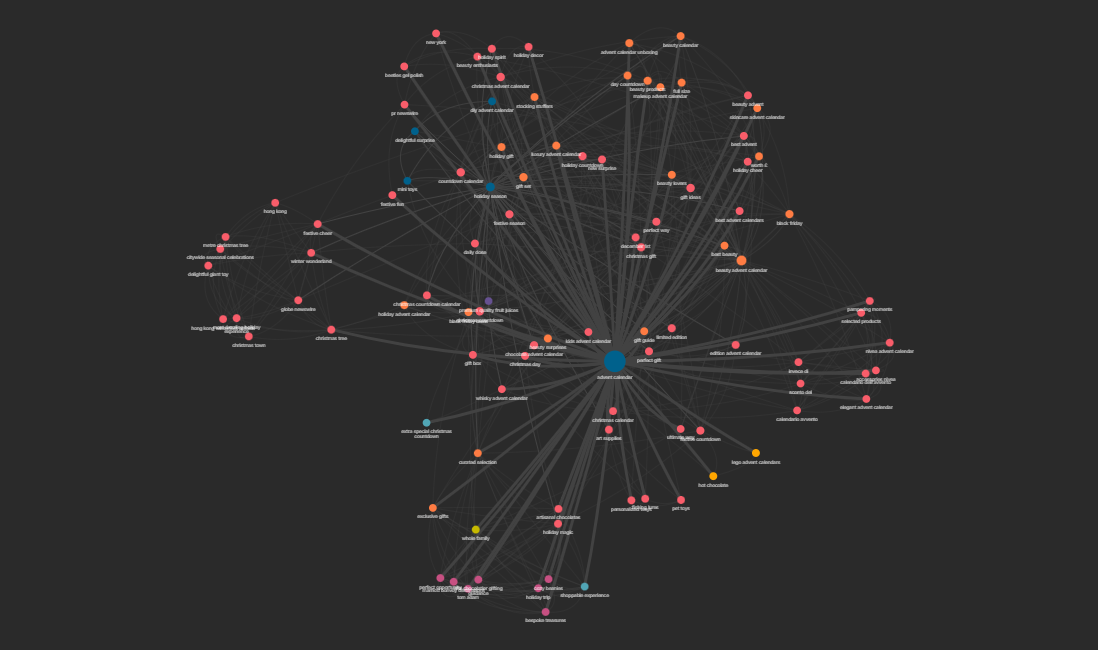
Conversation clusters in YouScan
It's gamification dressed as tradition, and people are getting better at seeing through the packaging. Social media doesn't just amplify this, it reshapes what the product is. An advent calendar used to be a private experience, maybe shared with family around the breakfast table. Now it's content. 24 days of posts, stories, reels. Documenting the unboxing is the point. You're sharing proof that you're participating in the cultural moment, that you're the kind of person who has an advent calendar worth filming.
That performance creates its own pressure. Once you've posted day one, you're committed to the narrative. Miss a day and the algorithm notices. Your followers notice. You notice. The calendar that was supposed to slow you down becomes another obligation. Another thing you have to show up for. Another tiny task on the list.
And yet people keep buying them. Keep setting alarms for drops. Keep joining wait-lists Keep paying £300 for 24 miniatures they could buy individually for half the price.
The cynical read is that we're all just marks in an elaborate con. We’re persuaded to buy repackaged samples at premium prices nudged by nostalgia and FOMO. There's truth in that. Beauty brands absolutely use advent calendars to shift old stock. Retailers know exactly what they're doing when they position these objects as limited editions that sell out in minutes.
But the cynical read misses something important though. People aren't stupid. They know the value proposition doesn't quite add up. They know the miniatures are samples. They can do the maths. They're buying anyway because what they're actually purchasing isn't the products inside. It's the structure. The permission to have something to look forward to in a month that often feels like endurance sport.
December is stressful in ways we don't talk about enough. The forced festivity, the financial pressure, the relentless social obligations, the darkness that settles in at four in the afternoon. For people living through economic insecurity, climate anxiety, political instability, the idea of guaranteed daily pleasure becomes genuinely appealing.
This is what makes the Gen Z embrace of advent calendars as self-care so poignant. The traditional markers of adulthood like home ownership, financial security, stable careers feel increasingly out of reach. What remains are these small rituals that you can control and complete.
An advent calendar is containable. 24 days. 24 doors. A beginning, a middle, an end. In a life that often feels shapeless and ongoing, that's not nothing.
The tension, though, is that this structure is entirely manufactured. You're not building toward Christmas. You're building toward the end of the product. The ritual has been hollowed out, the meaning replaced with merchandise. What remains is the form without the substance.
We've become very good at buying the appearance of things. Productivity tools that don't make us more productive. Meditation apps that don't make us calmer. Advent calendars that don't make December feel more meaningful. But we keep reaching for them because the alternative is harder than cycling through another round of hopeful consumption.
Are advent calendars authentic rituals? Are they cynical cash grabs? Are they both? Why are we so hungry for structure that we'll buy it pre-packaged from Selfridges? It means that anticipation has become something we can't generate internally anymore, that we need it delivered daily in miniature form.
Maybe the real luxury isn't the products inside the calendar. It's the fantasy that 24 tiny gifts can make December feel less overwhelming. That we can purchase our way into feeling more present, more grateful, more capable of experiencing joy. That if we just find the right calendar, we'll finally get what we're looking for.
We won't, of course. But we'll probably buy one anyway next year. And the year after that. Because the alternative is facing December empty-handed, with nothing to remind ourselves that we're worth something small and nice each day.
And honestly, that's the bit we need to figure out, how to do that without the packaging.