The Greenfinch and the Algorithm
You don’t expect parakeets in London. But then you hear them. They screech loudly as they zoom through the air, like a green-feathered bullets. They never stop by on my balcony though. I put out some food and get the occasional visitors: magpies, jays, even some crows and unfortunately the dreaded London pigeons, which I try to shoo away quickly. But never the parakeets.
As I sit here, a little jay watching me as it picks up a peanut, I cannot help but wonder if talking about birdwatching makes me sound like an old woman. It’s got that sheen of anoraks and retirement home. But recent statistics tell a different story.
RSPB (Royal Society for the Protection of Birds )-backed reporting says “almost 750,000” Gen Z birdwatchers are now regular birdwatchers, up 1,088% since 2018. That’s a tenfold rise. And the coverage of that statistic is almost entirely "isn't it charming that young people are going outside". There are a few jokes about binoculars. There is some light speculation about screen fatigue.
That's a mistake. Because if you're trying to understand how people are reorganising their attention, their identity, birdwatching is one of the most interesting signals. Not because birds are important (although they are), but because of what it reveals about the birdwatchers.
As an activity, birdwatching is like a game layer on top of ordinary life. You can do it in your garden (or on your balcony), on your lunch break, on the way to the tube. It rewards noticing things that are already there. What's actually happening is closer to attention training. Birdwatching is one of the very few activities that rewards patience in a culture that has been systematically training patience out of us for two decades.
That's the thing the "isn't it charming" coverage misses. This isn't people stumbling into a hobby. It's people actively seeking out an experience that works on completely different cognitive terms to the rest of their lives. No notifications. No optimisation. No audience (unless you want one). The wren either shows up or it doesn't. And no amount of refreshing will change that.
Which brings in the contradiction at the heart of this, and it's a more interesting one than the tired digital natives go analogue framing. The tools that are driving the birdwatching boom are entirely digital. Merlin, the Cornell Lab's bird ID app, identifies species from their song in real time using AI. There are live migration maps, gamified spotting platforms, TikTok communities. Technology isn't being rejected here. It’s actually being utilised to get people out of the house. The phone is the on-ramp; the experience is the destination. That's a meaningful difference. It suggests that what resonates with Genz and Gen Alpha may not be replacing screens with nature, but using screens as a means to get there.
There is also a darker undercurrent. Birdwatching's rise coincides with accelerating biodiversity loss. The birds people are suddenly paying attention to are, in many cases, disappearing. UK farmland bird populations have fallen by over half since 1970. The dawn chorus that the RSPB is encouraging people to wake up for, is measurably quieter than it was a generation ago. But watching something is not the same as protecting it. The aestheticisation of nature hobbies carries the risk that ecological anxiety turns inwards as a personal wellness practice rather than outwards as counter-action.
The class dimension is also largely absent from the conversation. The narrative of birdwatching as a newly democratic, accessible hobby skips over the fact that access to green space has never been equally distributed. Expensive binoculars, car journeys to nature reserves, the confidence to stand in a field without feeling self-conscious - none of these are neutral. Conservation communities have a long history of gatekeeping, of treating expertise as a barrier rather than an invitation. Social media has disrupted some of that. But it's also introduced new hierarchies: the influencer birder, the aestheticised nature account, the overcrowded habitat driven there by a viral video. Every authenticity movement eventually risks becoming content. Birdwatching is no exception.
For the best part of the last 20 years, everything was determined by how fast you moved, how much you produced, how visible and responsive you were. Birdwatching shows that a different set of qualities is starting to carry weight. The ability to be genuinely present rather than productively busy. Silence in things that don't scale.
Looking at YouScan social listening data and in the online birdwatching conversations in the UK, bird feeders (like the one on my balcony) sit at the very heart, generating by far the highest volume of discussion across both home and garden audiences: from practical concerns about cleanliness and contaminated food to species-specific excitement about garden regulars like blue tits and greenfinches. Garden birds more broadly form the second major hub, drawing in talk about RSPB guidance, the best times to feed, and the difference between what's helpful during winter months versus the summer.
Alongside these domestic conversations, a significant strand of discussion centres on conservation and decline. The co-occurrence of terms like "huge decline", "beautiful greenfinch" and "new advice" tells its own story: people aren't just enjoying birds, they're worried about them. That concern feeds directly into interest in official guidance from the RSPB, which appears consistently across threads about garden birds, seasonal feeding, and wild bird welfare more broadly.
The farmland bird cluster is another distinct and densely connected topic area, with winter stubble, autumn sowing, mixed farming, grey partridge, turtle doves, and the UK Farmland Bird Index all tightly bound together. This is clearly a conservation-literate audience engaging with agricultural policy and its impact on bird populations, a more specialist conversation but one with genuine depth and emotional investment, particularly around the turtle dove, whose call and decline both surface repeatedly.
Environmental threats generate a parallel cluster. Pollution incidents, chemical spills on the River Spey, caustic soda, and other wildlife all appear in close proximity, suggesting that birdwatching communities readily expand their concern to broader ecological damage when it intrudes into their landscape.
On the technology and research side, wind farms and offshore wind turbines draw consistent interest, typically framed around recent and surprising findings that challenge assumptions about risk to birds. Aberdeen Bay and low-risk assessments appear repeatedly in this cluster, suggesting the audience is following this debate with some nuance.
There's a notably distinct civic thread running through the data too: public spaces protection orders, blackberry foraging, clipboard warriors, and normal social interaction cluster together in a way that reflects frustration with over-regulation of outdoor and everyday activities. A conversation that touches birdwatching tangentially but speaks to a broader anxiety about access to the countryside and open spaces.
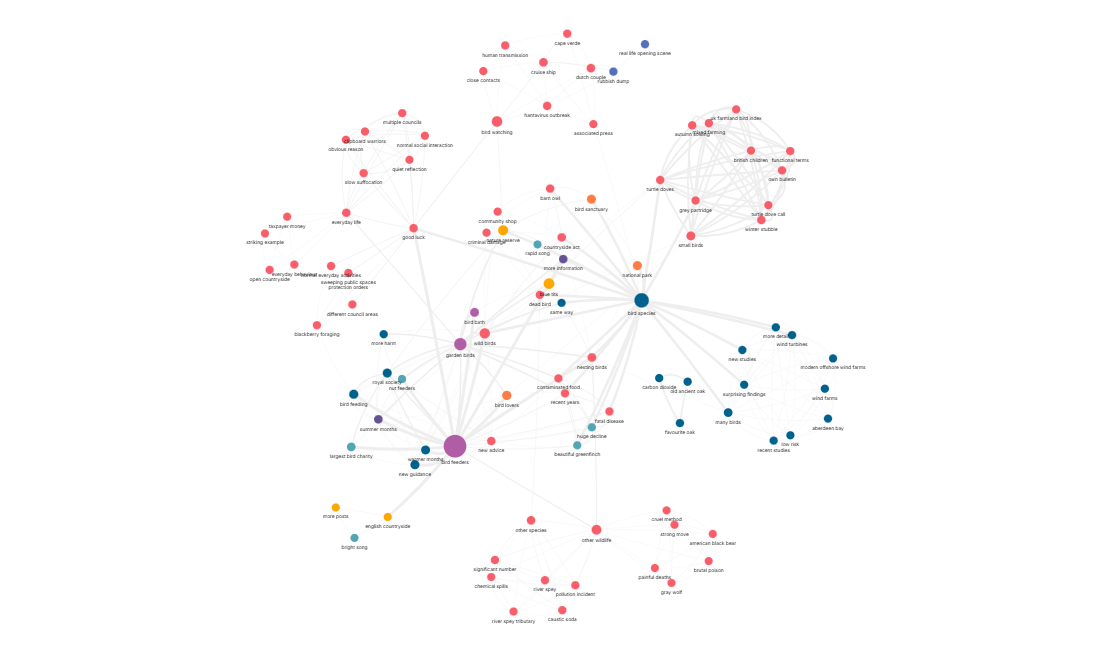
Conversation clusters in YouScan social listening data
Birdwatching sits inside a cluster of behaviours: foraging, cold-water swimming, pottery, analogue photography, gardening. All of them share the same underlying logic. They restore something. But not in a vague wellness sense. They require the attention that the digital slot machines of social media steal from us, and in return they replenish those depleted cognitive resources. It’s a holiday for your brain. The research on this is solid. Birdsong alone has measurable effects on mood and stress, and there's emerging evidence that regular engagement with natural environments slows age-related cognitive decline. These are the kind of outcomes that should be considered when we design cities, schools, workplaces and products.
The birdwatching boom is a signal that enough people are sufficiently depleted that they're reorganising their lives around nervous system repair rather than self-optimisation. The status symbol of the next decade might not be productivity. It might be the ability to sit still long enough to spot a greenfinch.