Someone Banned a Book. Everyone Read It.
Like so many celebrities, Dua Lipa has a book club. Unlike other celebrities, Dua Lipa has set up a banned books library in one of the most photographed bookshops on Earth, Livraria Lello in Portugal. It’s the kind of place that now charges an entrance fee and requires booking a timed slots, because too many tourists just took pictures of the ornate wooden staircase and left without buying a single book. Into that setting, the Manifesto Library drops 100 books that have been banned somewhere in the world, including Salman Rushdie’s The Satanic Verses, Margaret Atwood’s The Handmaid’s Tale and George Orwell’s Animal Farm. Each is sorted under the headings Control, Voice, Memory and Power. It is beautifully done. It is also what happens when a cultural problem gets adopted by people who are good at making things look desirable.
Whether it is Reese Witherspoon, Oprah or Dua Lipa, celebrity book clubs work by attaching a famous person's taste to a list of titles and that list moves units. But is reading a banned book actually resistance? Or is it a costume for resistance, worn somewhere entirely without risk? For most of the adults posting about it, buying it from a chain bookstore, adding it to a public reading list during Banned Books Week (an event that's been running in some form since 1982), there is no actual risk being taken at all. That's the complaint increasingly aimed at the "read banned books" framing: that it has drifted from an act of defiance to a selling point. Is this activism? Or is it a very tasteful form of brand-building that happens to align with a cause worth supporting?
The American Library Association (ALA) logged 5,668 outright bans in 2025, the highest figure it has ever recorded. PEN America found that banned non-fiction titles had more than doubled across the previous school year. It’s no longer just novels with sex scenes or swearing, but memoirs, histories, books about activism and civil rights. Elie Wiesel's account of surviving a death camp got pulled alongside romance novels and dystopian fiction. When the target list expands from "age-inappropriate content" to "documented history of state violence", it’s no longer about protecting the children.
ALA's own data shows that over 90% of 2025's challenges came from organised pressure groups, elected officials or appointees, up from about 72% the year before. Activists are circulating the same shortlists of titles from library board meeting to library board meeting, so that a challenge in a small Iowa district and one in Florida draw from the same script. That level of coordinated activity is something that a library opening in Porto, however well-meaning, cannot touch. This isn't happening in Portugal. This isn't a taste problem that can be solved through curation.
However, banning has never been a reliable way to suppress a book. It's actually a remarkably efficient way to advertise one. Gender Queer, A Clockwork Orange, Looking for Alaska, each banned book gets a new surge of attention, and sales, every time someone tries to remove it from a library shelf. But the people running these campaigns know that. Which means the point was never to erase the book from culture. Anyone with an internet connection and a credit card can still find it, buy it, read it. The real target is much, much narrower: that 14-year-old in a rural school district who has no easy way to get hold of it. No car. No library card in the next town over. No parent willing or able to buy it. In that context, banning is not about making Gender Queer disappear from the world. It is about restricting that small-town teenagers don’t get frictionless access to it.
A Clockwork Orange has been getting banned somewhere since roughly the year it was published. Moral panics about what teenagers should and shouldn’t be allowed to read are not a 2026 invention. What has changed is the coordinated machinery and what that machinery is doing to reading itself. The National Assessment of Educational Progress found basic reading proficiency among American twelfth-graders at its lowest point in three decades, the same year PEN America clocked its highest-ever tally of removed titles. Correlation is not causation. But both these facts show a failure to get books into young readers' hands from two different directions: one through under-resourcing and one through active removal. A library in Porto addresses neither.
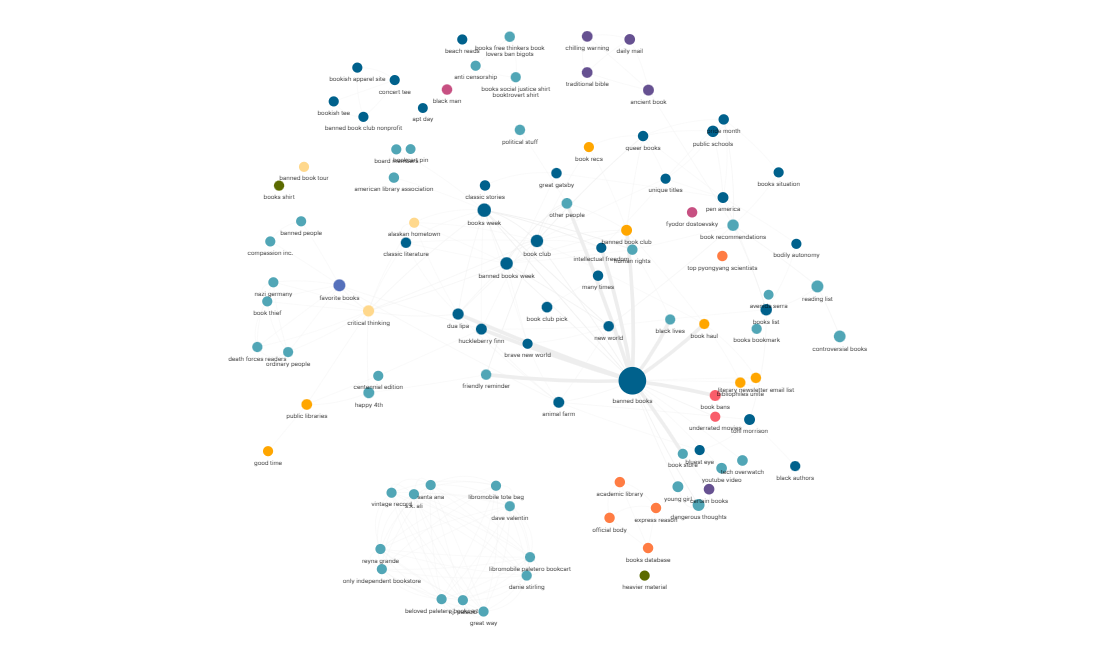
Looking at social listening data in YouScan, the data points to an emerging shift in how communities are responding to banned books. While much of the conversation focuses on institutional battles, a distinct and growing cluster reveals people bypassing traditional libraries and schools entirely. Instead, they are adopting a mobile model to bring books directly to neighbourhoods. This isn't limited to specific famous authors; the names appearing in the data (like Reyna Grande or S.K. Ali) simply reflect the diverse, often marginalised voices that these independent mobile book carts prioritise when mainstream shelves remove them.
YouScan Social Listening
By making book access transient, celebratory and community-run, advocates are creating a system that is much harder to restrict than a fixed library branch. The strong links between terms like "good time", "great way" and these mobile units suggest a pivot in tone: resistance is no longer just about angry protests or legal arguments, but about creating joyful, pop-up events that deliver banned stories directly to readers' doorsteps. This signals a future where access to controversial ideas rely less on institutional permission and more on mobile, local networks that can roll into a community and keep reading alive.