Something Borrowed, Something Branded
There's a rumour that Taylor Swift and Travis Kelce will get married at Madison Square Garden. The speculations are not just around the venue, there are dress theories (Ralph Lauren? Oscar de la Renta? Vivienne Westwood?), there are guest list confirmations (Zoe Kravitz?) and snubs (Harry Styles?) circulating on every platform. You could simply file this as celebrity gossips. But there is something really interesting lurking underneath the wedding industrial complex and Taylor Swift is just the most visible marker of it.
Looking at recent wedding trends, there seems to be an inversion happening. Historically, a wedding is a ceremony performed for the people in the room: family, friends, a community that actually knows the happy couple in real life. You may get a distant cousin or an odd +1, but there are usually far fewer than 6 degrees of separation. Now, branded weddings appear to be aimed at an audience that isn't actually there: a Vogue editor, a TikTok commenter, a brand partner, a future follower. And all the people who are physically present at the ceremony have been demoted from audience to cast.
You see the shift in industry numbers, but they don't explain it. Brands that have never sold a white dress are now launching bridal collections, because wedding content = organic engagement. A new category of professionals has emerged to manufacture perfect wedding content: publicists who spend upwards of ten months engineering a couple's wedding for editorial consideration in Vogue, stylists curating multi-day wardrobes for each event of an ever expanding wedding weekend, content producers hired specifically to shoot the day for social media distribution. One creator documented her wedding preparation across 62 separate TikTok instalments. The average US wedding now costs over 20% more than it did before the pandemic.
Social listening data from YouScan confirms how deeply content production has been absorbed into wedding culture. The emergence of "content creator" as a standalone category, sitting alongside makeup artists and photographers, signals that couples are now explicitly budgeting for social media output. This extends to the dress itself: the simultaneous prominence of "second look," "outfit change," and "reception dress" suggests the wedding day is being structured around multiple visual moments, each a separate shareable asset. The network graph reflects this, with these nodes forming a cluster around a central hub, indicating that they are discussed as a coordinated aesthetic strategy. Equally counter-intuitive is the framing of bridal jewellery as haul content: terms like "jewellery haul" and "jewellery unboxing" borrow the language of fast fashion discovery. The separation of "city wedding photographer" from "wedding photographer" as a distinct conversation further illustrates the inversion of traditional planning logic: the venue is now chosen for its visual properties first, then photographers chosen to match. Sitting above all of this, "posh picks" as a high-volume fashion term points to an audience constructing weddings as editorially curated experiences, translating a magazine-era aspiration for taste and curation into the social media language.
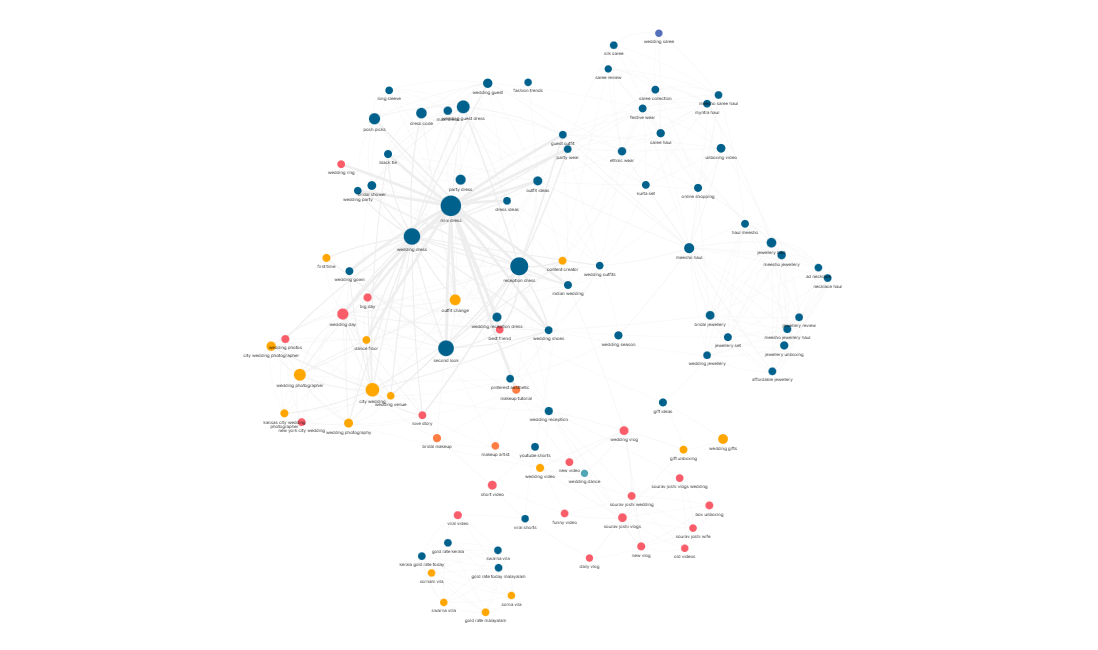
Social listening data from YouScan
None of this is incidental. There’s a hunger for this type of content. The industry did not create it, but they are happy to feed it. To understand that hunger, we have to zoom out. The majority of couples getting married are now from a generation which delays or skips the traditional milestones of adulting. Homeownership is financially out of reach for many. Career trajectories are non-linear and hard work no longer rewards you with a pay increase. Having children is a choice that some can’t make or don’t want to make. The wedding however is the one life event you can both control and monetise.
In a culture where anyone can claim influence, where follower counts gives anyone a certain kind of status, the wedding can prove who you are in a single post. If your wedding gown is a vintage Dior runway piece, that’s not just a dress. It's proof that your taste predates the trend. And it can't be copied by an influencer two weeks before your ceremony. If you book a $100,000 rooftop venue in a midtown office tower for your reception, that’s not just an eccentric choice. It's proof that you’re a trendsetter.
And then there is the Vogue feature. But it’s not the 90s, I hear you say, no one reads magazines anymore. That’s exactly the point. While Vogue's authority as an arbiter of fashion and taste has been eroding for years, for your wedding to be featured in Vogue is still verification. A Vogue spread is still confirmation that you are someone worth knowing about.
This is also why brands want in so badly. The bride is an emotionally credible spokesperson because she isn't selling anything. She is just planning the “most important day of her life”. That authenticity gives it commercial value. When a beauty startup sponsors an influencer's bachelorette weekend in St. Barths and generates 28,000 new website sign-ups in the following week, it's not because the product is good. It's because the happy vibes of the occasion rub off on everything it touches. The irony is that the more brands flood into this space, the less authentic the bride’s sponsored content becomes.
But what about the wedding guests? Some of them are spending thousands to attend a destination wedding weekend they couldn't really afford, buying new outfits for each branded event, venmoing for matching accessories they didn't choose. For those orbiting the bride, the wedding like this is more like being cast into someone else's production. If every bridesmaid, best man, wedding guest is also an extra in your content machine, then the wedding stops being a shared experience. The people who came to witness something real leave having performed something instead.
What gets lost in the branded version of a wedding is the meaning of the ceremony. The wedding was always a performance, but it was a performance of belonging. You stand in front of the people who you know and who know you, you make a promise, and they witness it and they celebrate with you. They will remember the day. The stranger watching your 60-second, professionally-produced TikTok won't remember it. The Vogue reader leafing through the magazine at their hairdresser’s won’t. A branded wedding replaces a finite and familiar audience with an infinite and anonymous one. What makes a wedding meaningful to the people in the room are the awkward best man speech, the aunt who ugly cries, the funny anecdote of how the couple met. And those are precisely the things that don't travel. They don't make good content. So they get edited out. What reaches the stranger on the internet is a beautiful void. What the branded wedding gains in reach, it loses in substance.
Taylor Swift may or may not get married at Madison Square Garden. Whenever and wherever it happens, the coverage will be extraordinary. And somewhere, a woman who isn’t famous, who is planning her wedding and is already behind on the content calendar, will watch it and feel the pressure to make her own day match a standard of someone else's life. That feeling is the real product of the industrial wedding complex. The feeling that whatever you're planning, it won’t ever be enough.