As I was scrolling through my Instagram feed (I call it research) last month, inbetween all the trending or meme-based Halloween outfits, I spotted the occasional legwarmers, headbands and outfits made out of synthetic material, in colours not seen in nature. Kids nowadays... They don't even know who Jane Fonda is. They were not even alive when she released her workout tape. They don't even know what a VHS is. Or do they?
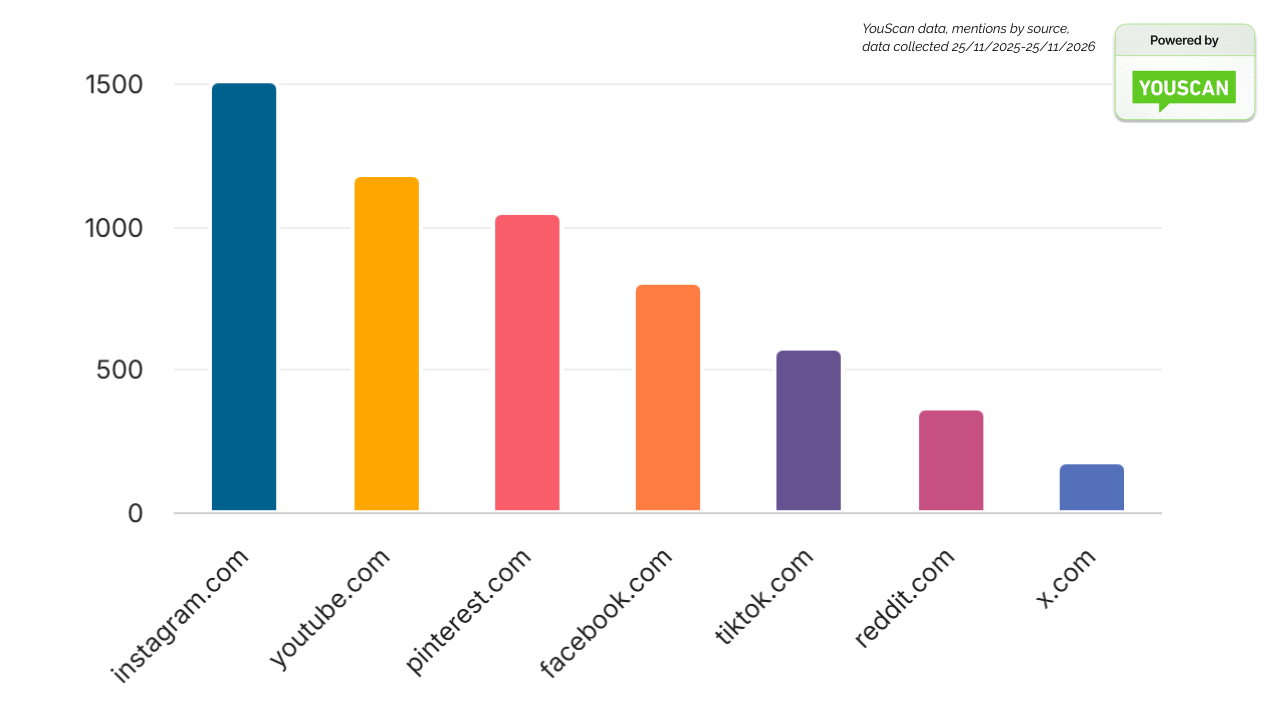
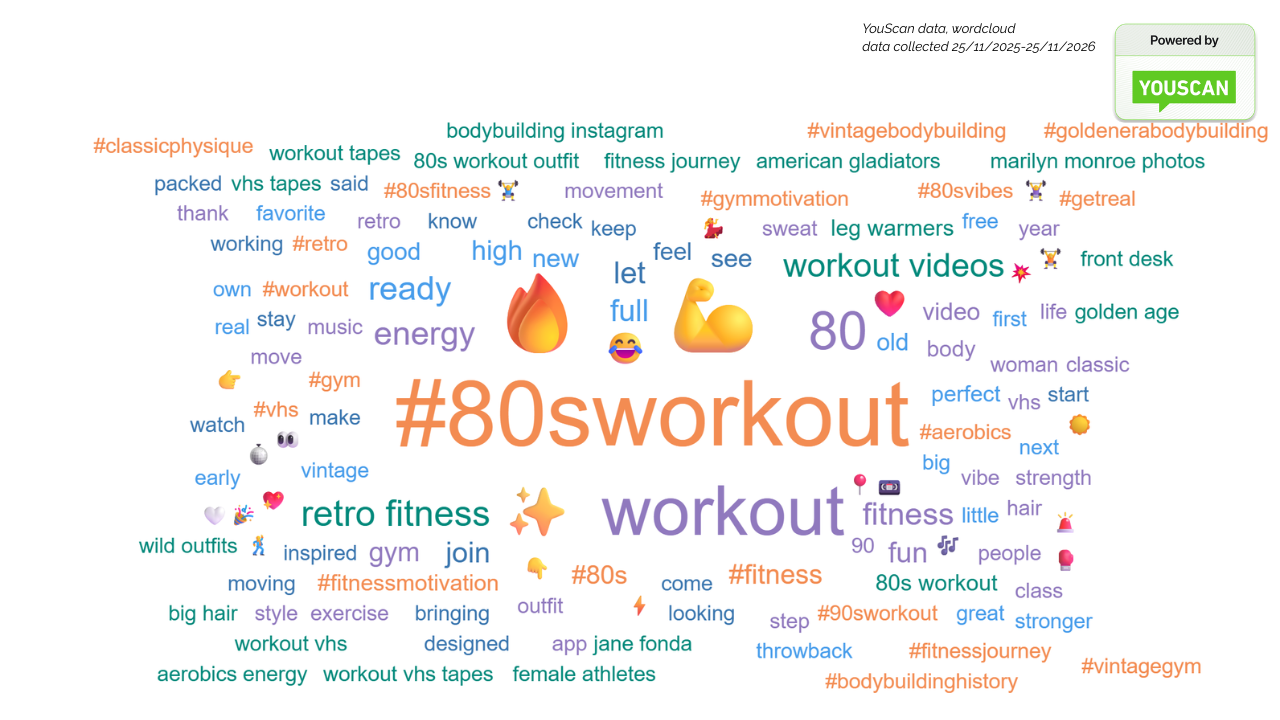
I popped the query into YouScan to see what if there are any conversations still about VHS fitness tapes that boomed in the 80s and 90s. Unsurprisingly, it is not a huge topic. The aesthetic of that era is mainly being talked about. Then there is the nostalgia of someone remembering their mum's tape, remembering that the exercises were a lot harder than they looked. People still doing these workouts were a lot harder to find. Like the Right Babe Body Club in Omaha, Nebraska running follow-along VHS exercise classes.

Exercise today is a solitary, data-driven, optimisation challenge. But it was not always that way. We lost something when we stopped dancing in our living rooms and started listening to algorithms.
Let's dive into the neon-soaked fitness boom of the 80s and 90s. The big bang of this industry is Jane Fonda with her 1982 release of Jane Fonda's Workout.
If you wanted to get into shape in the late 70s, where did you go? Gyms existed but not in a way we know them now. They were heavily male-dominated spaces, largely rooted in body-building, power-lifting or boxing. Intimidating and hostile to outsiders. For a woman looking to build cardiovascular fitness, it did not offer any entry points. As these spaces did not welcome them, Fonda could bypass gyms entirely by bringing the workout into women's living rooms. And the concept took off immediately. The tape sold 17 million copies globally, which also drove the adoption of the VCR. The product was a place to be bad at exercise unobserved, and the VCR was the price of that privacy. The software forced the hardware into the home. just so that they could work out along an actress in a stripey leotard.
Nowadays you can find the whole routine on YouTube. And it is fun to watch. The theatricality of the era made it fun. A modern fitness video is sterile by comparison. The 80s exercise videos are packaged as a performance. Fonda disguised a painful, rigorous exercise routine in a bouncy, brightly coloured routine. She brought it into a domestic sphere. the living room, and turned it into a space of building physical strength. This gave psychological safety, removing the male gaze and the fear of judgement. And in the process, she proved that there was a multi-million dollar market waiting to sweat on their carpet. And that opened the floodgates.
VHS exercise tapes needed to offer entirely different emotional experiences to capture market share. Richard Simmons and his Sweatin' to the Oldies was a visual and cultural shift. Unlike Fonda's videos, Simmon's studio is not filled with elite dancers or fitness models. He intentionally cast older, larger and uncoordinated people, so watching it made you feel part of it, you felt seen. The fitness industry has historically relied on a deficit model, convincing people that their bodies are flawed and can only be fix by buying whichever product they are selling. Simmons promoted movement as a celebration of a body you currently have, rather than a punishment of the body you don't have. But the deficit model is the business model, and Simmons was the one operator who didn't need you to feel bad. So the market moved on from him.
As the 90s approached, the market became saturated. Personality, escapism and joy were no longer enough to guarantee sales. The industry needed a new gimmick and pivoted towards the hyper-specificity of honing in on a single muscle group. The holistic approach was gone and it was replaced by buns of steels, thighs of steels, abs of steel. Suzanne Somer's Thighmaster even translated that into a device. The inclusivity of Simmons was gone and it was replaced by disassembling the human body into a collection of unrelated problems that each require their own VHS tape and piece of plastic hardware to be solved. It feels like the analogue precursor to toxic Instagram filters, training people to zoom in on their deepest insecurities.
But why did this so strongly resonate with people? For someone who was overwhelmed by spending 60 minutes on full body fitness, for whom Jane Fonda was way too intense or Richard Simmons too chaotic, just focusing on one body part made this manageable. Fitness became bite-sized and made it an achievable goal. Breaking the body into problems made progress feel completable, and completable things get repurchased. So it also created a perpetual cycle of needs: once you fixed one thing, you needed to buy another VHS tape to fix another. That's the same mechanic as the step counter: a small, finishable target that's never finished.
Once the industry realised that you no longer needed a certified fitness expert to sell a fitness VHS tape, the goldrush really started. All that was needed was celebrity aesthetic. And those celebrities were ready to cash in.
The transition point was Cindy Crawford's 1992 release Shape Your Body. It's the zenith of celebrity fitness tapes. The presentation was all MTV. It was filmed on beaches and rooftops, featured stylised, black-and-white cinematography and the soundtrack featured mainstream artists of the time, like Seal. Crawford was not just performing the moves, she inhabited an aspirational lifestyle. Strength became fashion. Effort was repackaged as a look. It was the full monetisation of aesthetic capital. The body became the ultimate luxury brand and the tape was the low-cost entry point to the celebrity mythos.
The success of Shape Your Body signalled to every agent that their client needed their own VHS tape - stat. And the sheer volume and absurdity of the resulting tapes is staggering. It became a format where the entire selling point was proximity to the celebrity. Cher released Body Confidence which included the segment Hot Dance. Cher is full-on Cher - no sensible aerobics gear but a sheer, bedazzled bodysuit, instructing viewers how to do the pony. Trust transferred from competence to proximity, so the product became the relationship and the exercise became incidental. People no longer bought a rigorous exercise routine. They purchased a parasocial interaction. They wanted to spend an hour pretending to hang out with Cher.
The most broken example of this cashgrab era is Fabio Fitness. Released in 1993, from minute 1, Fabio has zero interest in being there. The routine is actually performed by a pro trainer, who holds everything together by a thread, She demonstrated all the exercises, explains them and keeps up the energy. Meanwhile, Fabio is constantly spacing out, he's not sweating, he's not even trying. And the only way the trainer can engage Fabio in his own workout video is complimenting his own body. It sounds less like a fitness routine and more like paying $20 to watch a celebrity admire themselves in the mirror for an hour, while a trainer called Brenda manages his ego. Fabio is the logical endpoint: the celebrity no longer needs to do the effort, only be present while someone else does it.
Why did these tapes exist? If Cindy Crawford represented the aspirational peak of the VHS fitness tapes, Fabio represented the empty calories, the sheer spectacle of celebrity. Beneath the surface of glamour and parasocial connection, a different undercurrent was driving a different segment of the home fitness market. If the celebrities were selling proximity to fame, other corners of the market were selling sex.
In the VHS era, the boundaries between physical exercise and sexual desirability began to blur. In 2003, Carmen Electra released Aerobic Striptease on DVD - same pitch, new format. There is one move in which Electra instructs the viewer to put their finger in their mouth and suck on it. The tape promised to tone your body like a dancer's, but its primary stated goal was to spice up your personal life. At least she was honest about that. Exercise and desirability were always sold together. Crawford and Electra differ only in how openly they say it.
This brings us to where we are today. VHS culture is fading into obscurity, literally, The physical media that documented this bizarre fitness era is rotting. VHS uses magnetic tapes, which decay over time. There are archivists who are actively hunting down these tapes in thrift stores and basements, before the VCRs vanish completely. This archival work is vital because exercise tapes don't get re-issues. There is no Criterion Collection for Fabio Fitness. A 1988 tape of Angela Lansbury doing on-land swimming (really!) is not getting remastered in 4k.
We have traded the VHS tapes and legwarmers for an Oura ring and an Apple watch. The purpose of movement has changed. It's no longer the joy of exercise or community, but biological accounting. It's walking on the spot at 11.30pm because you are still 256 steps short of your arbitrary daily step count. The neurological impact of this is significant. This is moving the motivation from intrinsic (this is making me feel good) to extrinsic (I'm going to get a digital badge). If we zoom out and review the arc of the last 40 years, the contrast is stark. We traded a relationship with a instructor, even a recorded one, for a relationship with a biometric sensor. Knowledge about our body is important. But it is only valuable when it is applied holistically, integrating the data with the human experience. We allowed movement to be a problem that required constant, quantifiable optimisation. At least it was funny. There is no humour in a smartwatch telling you that your cardiovascular fitness is suboptimal. The analogue soul of the VHS fitness tape, for all its flaws, allowed for physical imperfection rather than pushing for algorithmic compliance.
What will the next era of fitness look like? Will there be a data rebellion? Next time you go for a walk, leave the smartwatch at home. Don't count the steps and see how your body feels when it is not being surveilled. Then put on the leg warmers and feel the burn.