The iPod Is Back. And It Has Nothing to Do With Nostalgia.
I have an iPod. It’s an iPod Classic, 6th generation. 120GB of music I curated and digitised from my CDs over years. When I bought it in 2009, the iPod had already started its journey into obsolescence, when Steve Jobs pulled an iPhone from his pocket in 2007. I haven’t used mine in years, I occasionally charge it aspirationally in a wave of nostalgia but then go back to my phone to listen to my music. Yet, nearly 20 years later, searches for "iPod" on eBay have grown more than 8% compared to previous years. And if you were planning to buy a refurbished iPod now, you would now pay 60% more than in 2023, and you’d have to fork out up to £600 for some models. Why is there a sudden interest in a that Apple no longer manufactures?
You could look at the iPod revival as a Y2K aesthetic. The same nostalgia that brought back low-rise jeans and disposable cameras. But nostalgia is passive, sentimental, backward-looking. So this only partly explains the reasons for their comeback.
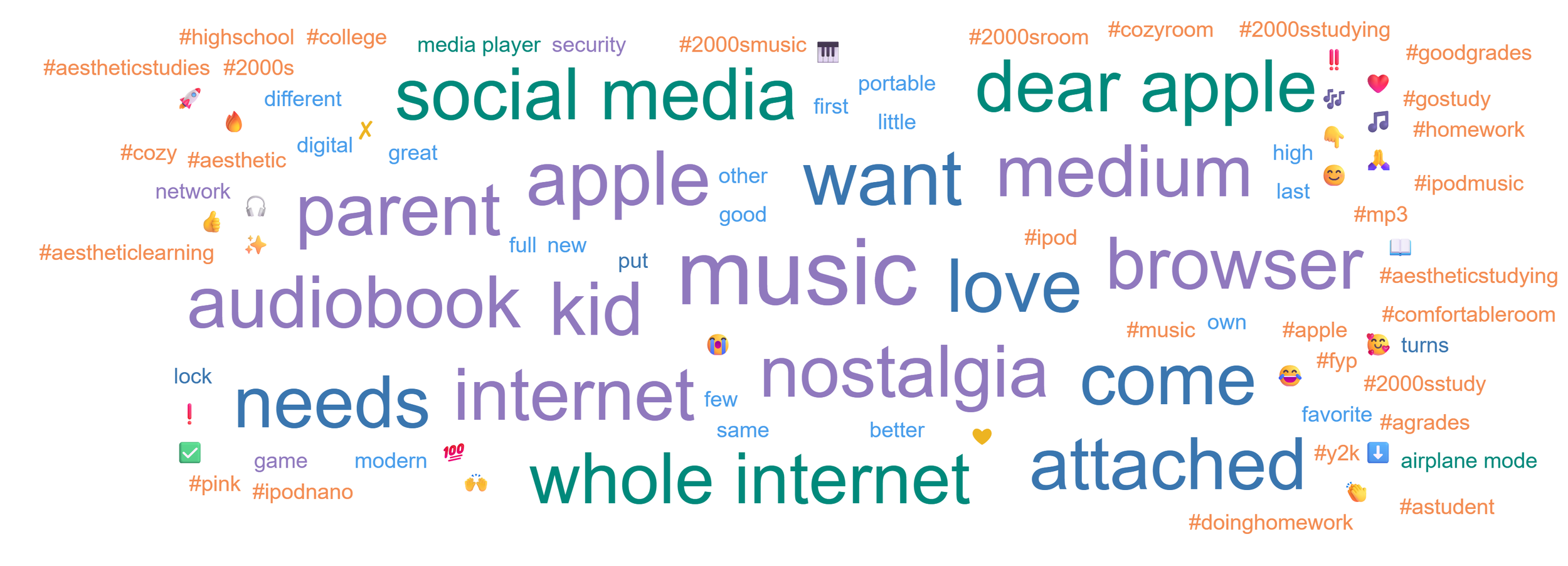
When I looked at YouScan social listening data, it became clear this isn't just a group of people missing the 2000s. The data actually shows a pushback against the current Apple ecosystem and the way the modern internet works. A large volume of the mentions stems from a viral open-letter style trend tagged "dear apple, the ipod needs to come back" where users are venting about the "dollar economy" and platform fees. The data also shows that parents are using iPods as a hardware-level parental control. They are specifically looking for secure lock devices that stay in airplane mode to give their children music and audiobooks without the risk of always-listening mics or algorithmic rabbit holes. Thereby it becomes less about romanticising the past and more about using old, familiar technology to opt out of the modern data-tracking model. And that distinction is the lens through which you have to read this revival.
Rather than a retro gimmick, the resurgence of single-use devices like iPods and other mp3 players can be seen as a search for disconnection and self-determination. The main attraction is its limitations: wired headphones only, a click wheel to navigate the menu instead of a touchscreen, no connection to the internet, no notifications. All of these should make the iPod unattractive to the digital native. But it’s quite the opposite. It’s nostalgia for the 2000–2010 era of "liminal tech": online enough to explore yet offline enough to feel private. The 2025 IPA TouchPoints survey found that British adults aged 15+ now spend an average of 7 hours and 27 minutes per day consuming screen-based media. For younger generations, raised with smartphones and seamless tech at their fingertips, choosing a single-purpose device is deliberately opting out. The iPod, the dumbphone, the film camera - what connects them is not just the Y2K nostalgia. In a world of infinite-purpose devices like smartphones, a single-purpose device like the iPod stands out. A music player you can only use for listening to music. A phone you can only use for making phone calls. A camera you can only use for taking photos. It’s opting out of devices that scream for attention with constant notifications.
To understand why, you have to look at what streaming actually did to our relationship with music. Streaming changed who owns the relationship. The streaming model promised access to everything for a monthly flat fee. But you aren't buying music. You’re renting access to it, on someone else's terms, inside someone else's infrastructure, curated by someone else's algorithm. The catalogue can and does change without notice. The price can and will rise. The platform's commercial interests will always take precedence over yours. The music you love doesn’t belong to you. You are a tenant, not an owner. And the landlord, it turns out, is also in the business of selling your attention to advertisers and routing money to AI military contractors.
Music curation takes the iPod revival beyond pure sentimentality. Curating a digital music library takes time and effort and it requires intention. But unlike music streaming services, it also means you own something tangible. For me as a Gen Xer, this feels completely normal. I grew up with vinyl, cassettes and CDs. I owned a library that I digitised and I never switched to streaming. But for the younger generations, it’s not the same starting point. They started with streaming as the default and placed themselves at the mercy of platform decisions.
It’s not just music streaming though. Letterboxd is a cultural analogue. On Netflix, you watch things. On Letterboxd, you have a relationship with films: you rate them, log them, write about them, build a visible record of your taste. This is in direct contrast to the Netflix model, which actively discourages you from forming opinions by auto-playing the next thing before the credits roll. By switching from social media to Substack, writers are trading audiences of millions for audiences of thousands. A Substack subscriber list is yours and the relationship is direct.
In each case, the move is the same: away from algorithmic abundance, towards curated simplicity. Building a collection of owned digital files, whether on an iPod or another mp3 player, is an act of self-determination. It forces decisions that streaming deliberately eliminates. What do I actually want to listen to? What is worth paying for? What deserves a permanent place in my life rather than a temporary slot in a queue? These are the questions through which taste is formed and identity is constructed. Streaming's infinite abundance removes the necessity for preference. When you can have everything, the necessity to know what you want does not exist
Take the logic further and you can see the outline of where this could lead. If the iPod is the music industry's version of intentional disconnection, what's the film industry's equivalent? The DVD with director's commentary, a format that demands you sit with a single work, listen to someone explain why they made it, and engage with it as a cultural object rather than a consumable. That might sound fanciful, but the appetite for depth over breadth is real, and it's growing.
Switching to iPods is also the reintroduction of friction, as younger people embrace more hands-on experiences over algorithmic ease. It’s the process of manually loading a set number of songs onto an iPod instead of letting a streaming app curate a playlist for you. Friction is not the enemy of pleasure. It is often its requirement. The effort of hunting down a record, paying for it, and loading it onto a device is also the effort of deciding what matters to you. Passive consumption produces passive listeners. You’re not consuming culture, you are curating it. And that curation requires taste.
Curating a music library costs money and time though. At current Bandcamp prices, rebuilding even a modest collection of fifty albums represents a serious financial commitment. The move from streaming to ownership carries a whiff of elitism - the same whiff that makes independent bookshops, farmers markets, and artisanal anything signifiers of a particular kind of taste-conscious affluence. Friction, reframed as intention, becomes a status signal. The effort required to build a curated library is part of its social value. So this is a barrier that needs to be considered, rather than romanticising iPods as democratised access to music.
If we were collectively shifting back from streaming to owning, then this would impact how music gets made and distributed. By rewarding volume of streams over depth of engagement, the streaming model favours singles over albums and background listening over active attention. If people migrate back towards ownership by buying digital files on Bandcamp or rebuilding personal libraries song by song, then artists who make albums designed to be listened to in full, will benefit.
On the flipside, there is music piracy. Streaming was itself, in part, a response to piracy. Spotify's origin story is inseparable from the wreckage of Napster. A generation accustomed to all-you-can-eat access for £10.99 that suddenly wants to own music may not be willing to pay per album. So a return to iPods could also signal a return to music piracy.
This is where the revival connects to the broader cultural movement towards offline: analogue photography, physical books, handwritten notes, dumbphones, slow media, local everything. The underlying logic is a rejection of the total-convenience model. And the belief that effort, attention, and limitation are not problems to be solved. They are the requirements needed for meaning to be made. Big tech is selling a vision where effort becomes optional. But the iPod buyer is declining that offer.
But does this signal the beginning of a genuine structural shift or just another niche? Streaming numbers continue to climb. The mainstream hasn't moved. Are the people buying old iPods and new Bandcamp credits today, those tastemakers who are setting tomorrow’s trends?
We have moved from the ownership model - vinyl, cassettes, CDs, digital downloads - to the access model of streaming audio and video. What the iPod revival suggests is that neither model fully satisfies on its own. Streaming solved the scarcity problem and created an excess problem. Ownership solves the excess problem but reintroduces cost and effort. The logical next step isn't a return to one or the other. It's a hybrid, where people maintain curated personal libraries of music that genuinely matters to them, supplemented by streaming for discovery.
That's already how some listeners operate. They use streaming to find things, then they buy the things they love. The iPod is the tool that makes the second half of that equation feel real: a physical (or at least dedicated) device for the music you've decided deserves a permanent place in your life, rather than a temporary slot in an algorithm's queue.
The device is almost beside the point. What people are really buying is the act of choosing.